
Basic system — 5 kWp PV, 5 kWh battery, two deferrable loads#
Type: Tutorial — learning-oriented, follow step by step.
This scenario adds a 5 kWh battery to the previous tutorial. The optimizer now schedules battery charge/discharge alongside the deferrable loads.
System#
Component |
Value |
|---|---|
PV |
5 kWp |
Battery |
5 kWh nominal, default charge/discharge limits |
Deferrable load 1 |
water heater, 3000 W |
Deferrable load 2 |
pool pump, 750 W |
Optimization mode |
dayahead-optim |
Cost function |
profit |
Configuration#
The only change versus Basic — PV is enabling the battery. In Add-on options:
set_use_battery: true
If you want to override the defaults (shown below — adjust to your hardware):
set_use_battery: true
battery_discharge_power_max: 1000      # max discharge power, W
battery_charge_power_max: 1000         # max charge power, W
battery_discharge_efficiency: 0.95
battery_charge_efficiency: 0.95
battery_nominal_energy_capacity: 5000  # Wh (= 5 kWh) — default
battery_minimum_state_of_charge: 0.3   # default
battery_maximum_state_of_charge: 0.9   # default
battery_target_state_of_charge: 0.6    # default — also used as default soc_init/soc_final when not passed at runtime
For the meaning of each parameter and acceptable ranges, see Configuration.
Run#
curl -i -H "Content-Type: application/json" \
     -X POST -d '{}' \
     http://localhost:5000/action/dayahead-optim
Output#
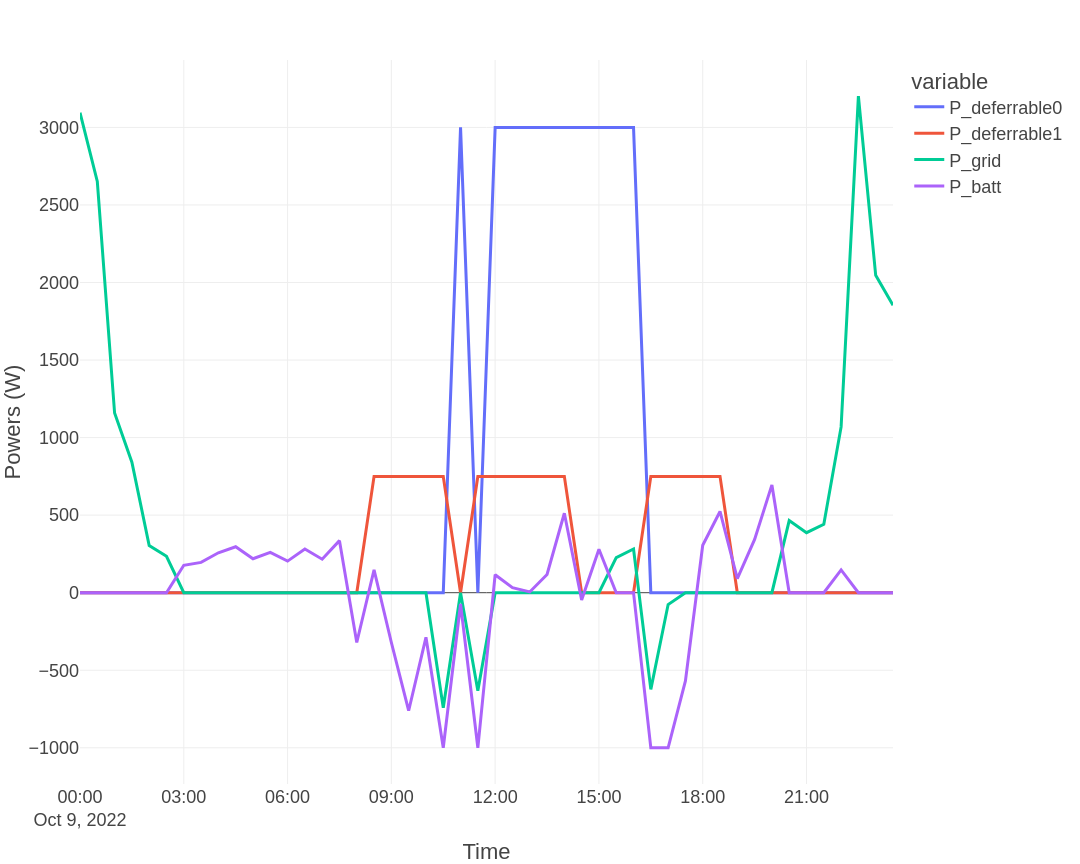
Optimization result:
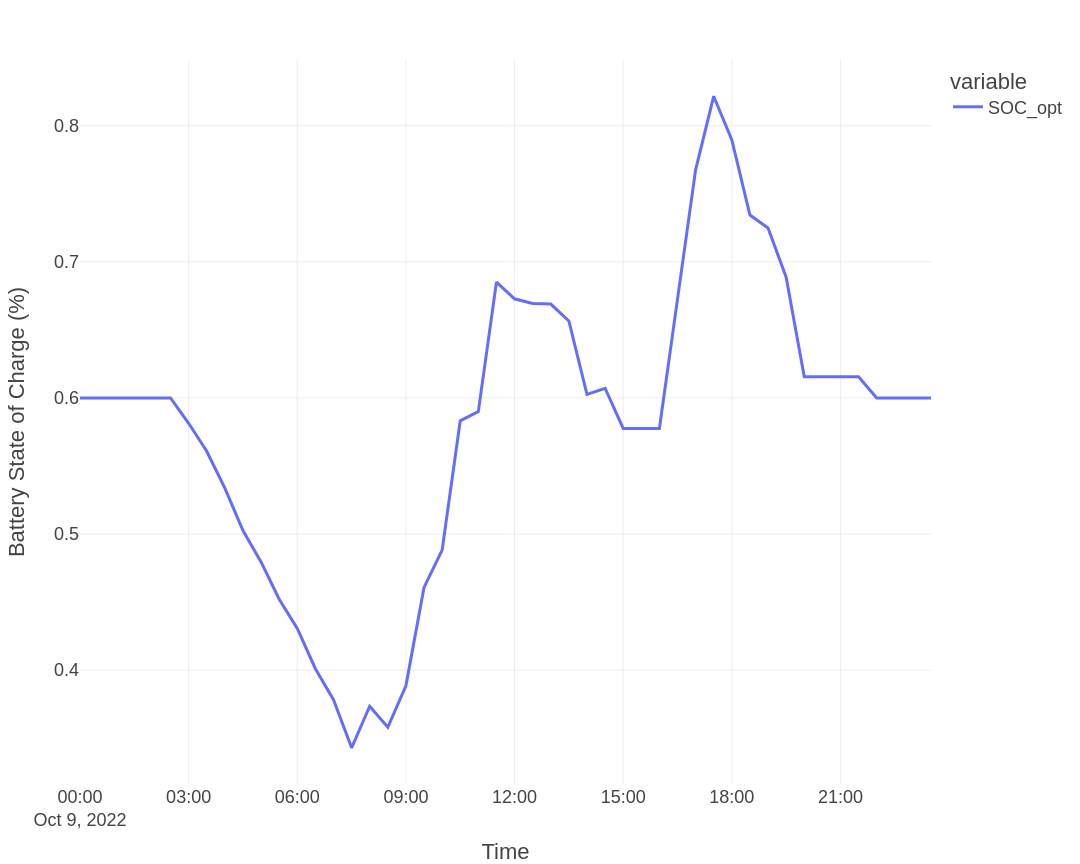
Battery state of charge:
Cost function: −1.23 EUR, compared with −1.56 EUR for the same system without a battery. With costfun: profit, the cost function expresses net cash flow over the period (positive = revenue, negative = expenditure), so a less-negative value means lower net cost — adding the battery here reduces the day’s net spend by about 21%.
Interpretation#
Battery shifts surplus PV from midday into evening peak hours, avoiding grid purchase during expensive hours.
The SOC curve typically rises during peak PV (charging) and falls during peak load + peak price (discharging).
The improvement size is sensitive to the spread between import price and export price. Low export prices (or none) make the battery more valuable; high export prices reduce its marginal benefit.
The
battery_target_state_of_chargeparameter is used as the default for bothsoc_initandsoc_finalwhen neither is passed at runtime, so the optimizer plans the battery to start and end at this fraction. For rolling-horizon control, see the MPC walkthrough.
Note
SOC convention. SOC_opt is a fraction of nominal battery capacity (0.0 = empty, 1.0 = full). The configured operational bounds do not rescale the value. See Good Practices, section 3 for the full discussion and source-code reference.
See also#
Tutorial: Basic — PV (same system without battery)
How-to: MPC walkthrough for rolling-horizon control with battery
Reference: Configuration for all battery parameters
Explanation: Good Practices — SOC semantics, forecast quality, infeasibility triage